From paper to screen
A seamless transition from your lessons to digital assignments.
Keep the materials you've built over the years. READU turns them into interactive assignments your students can open on any device.
Keep the materials you've built over the years. READU turns them into interactive assignments your students can open on any device.
 Demo video
READU's built-in PDF course creator has you covered. Upload your notes or a PDF and it automatically becomes a ready-to-teach course.
Now see how each of your students is doing, and give feedback in seconds.




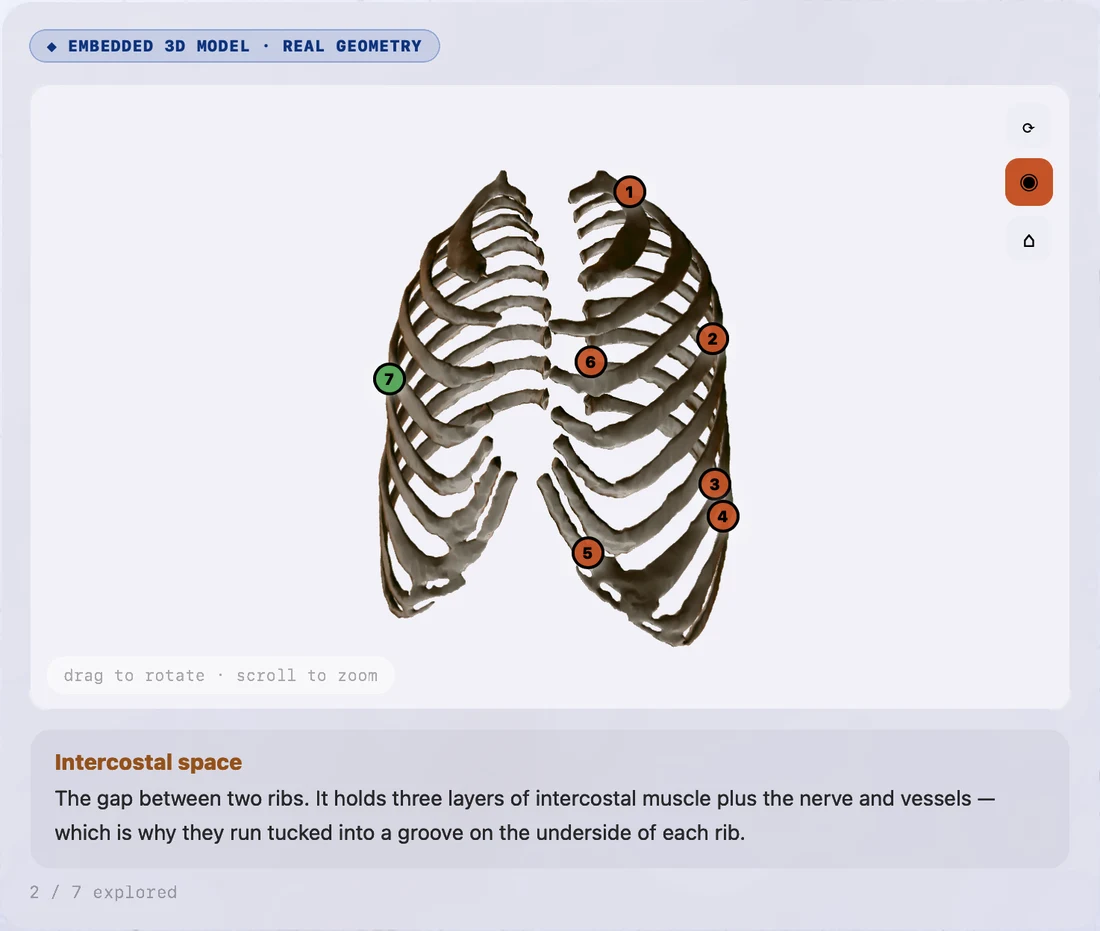
The notes, worksheets and PDFs you already teach from are enough. Scan or upload them and READU builds the interactive course for you, with summaries, 3D models, quizzes and class games.
Upload the material you planned to use anyway and READU turns it into a course for your class. While students work, READU tracks 110 parameters for each of them, so you see how long every step took, where they got stuck and who needs the most support.
Package what you already teach into an interactive course and sell it on the READU marketplace, so students can learn from it anywhere, even when you're not in the room.
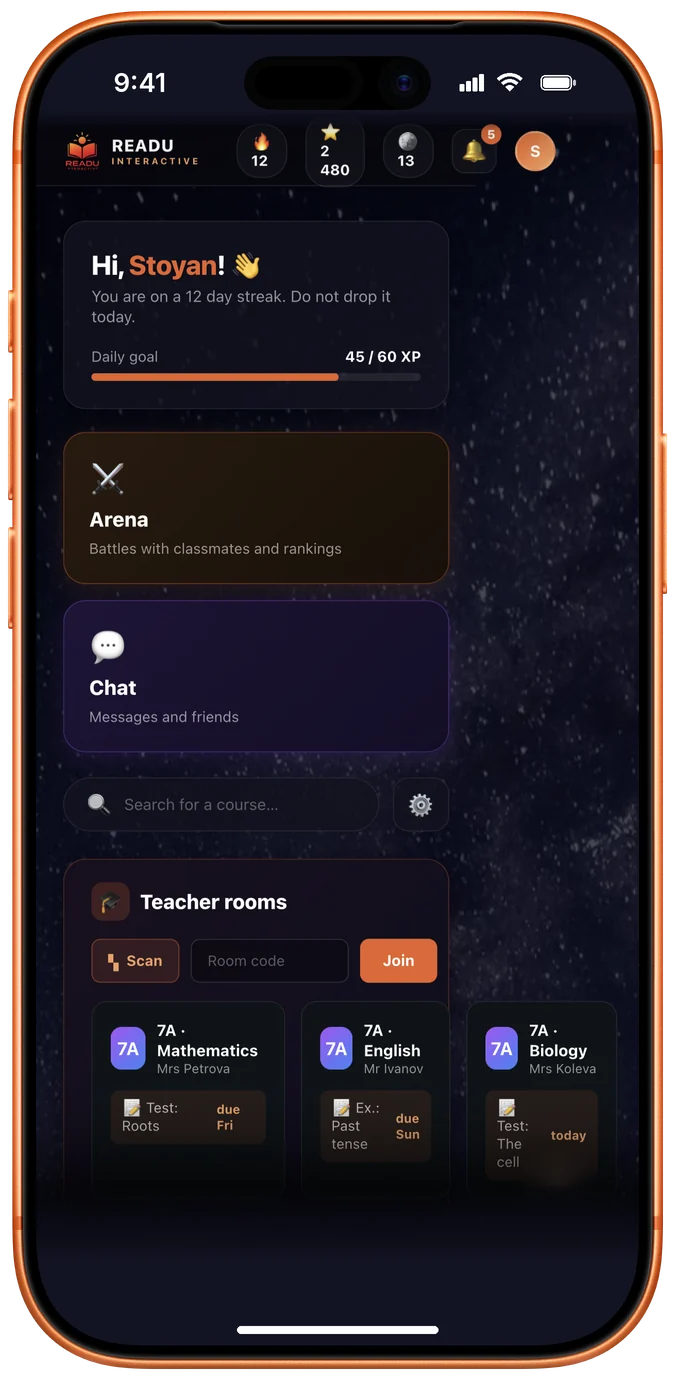
Your teachers' lessons and homework appear in your rooms. Hints help when you're stuck.
3D models and simulations you can play with. Try the real thing in step 3.
Try an interactive lesson →Quick rounds against your class, for every grade. Your teacher can turn any lesson into a game.
Daily goals, streaks and XP. Smart review brings back what you're about to forget.
Quick interactive games for every grade, from times tables to chemistry. Students compete with their class, earn streaks and keep coming back. Try a round.
Time spent learning, how much was correct and which topics were mastered.
See where your child is strong and where a little help would go a long way.
A gentle alert when your child is stuck on a topic, with a link to the lesson that helps.
Tell us a little about your school and we'll set up a free pilot for your teachers and classes.
Open the full result and try again as often as you like with a free account.
Graphs, a physics simulation and 3D models. Finish one task.
Upload a PDF (or use our example) and watch it become a lesson.
See a live class and send feedback in seconds.
Stretch and move the curve y = a·√x + k. The graph redraws as you drag.
The graph of y = √x starts at the origin and rises more and more slowly. In y = a·√x + k, the number a stretches the curve up and k moves the whole curve up or down.
At x = 4, √x = 2, so y = 2a + k. That is why a = 3, k = 0 and a = 2, k = 2 both pass through (4, 6).
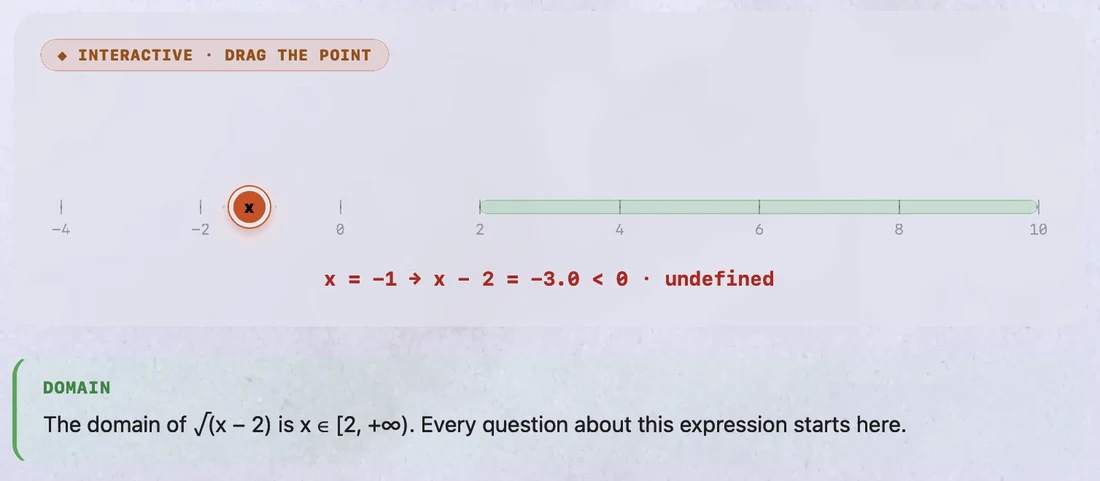
You can't take the square root of a negative number, so the domain is x ≥ 0.
Hint: √9 = 3, then 2 · 3 + 1.
How long each step took, which hints were revealed and where you slipped, not just the final answer.
| Step | Time | Hint | Mistakes |
|---|
Set the angle and speed, then launch. The path follows real physics (g = 9.8 m/s²).
A thrown ball follows a curve called a parabola. Its sideways speed stays the same, while gravity pulls it down by 9.8 m/s every second.
Without air resistance, 45° gives the longest range for a given speed. 30° and 60° land in the same spot.
45° splits the speed evenly between going up and going forward, so the ball flies the farthest.
Hint: At the highest point it has stopped rising and has not started falling yet.
How long each step took, which hints were revealed and where you slipped, not just the final answer.
| Step | Time | Hint | Mistakes |
|---|
Drag to rotate the 3D model. Unzip it to see how DNA copies itself.
DNA is two strands twisted into a double helix. The strands are joined by base pairs: A always pairs with T, and G always pairs with C.
When DNA unzips, each strand becomes a template for a new one. That is how a cell copies its DNA before it divides.
G and C always pair, held by three hydrogen bonds.
Hint: A pairs with T, T pairs with A, G pairs with C.
How long each step took, which hints were revealed and where you slipped, not just the final answer.
| Step | Time | Hint | Mistakes |
|---|
Switch between molecules and drag to turn them. Notice how the shape changes.
Atoms in a molecule share electrons in bonds. The bonds push each other as far apart as they can, and that gives each molecule its own 3D shape.
Water is bent (104.5°), carbon dioxide is a straight line (180°) and methane is a pyramid with four corners (109.5°).
In CO₂ the two oxygen atoms sit on opposite sides of the carbon, at 180°.
Hint: One carbon atom plus four hydrogen atoms.
How long each step took, which hints were revealed and where you slipped, not just the final answer.
| Step | Time | Hint | Mistakes |
|---|
Plants make their own food through photosynthesis. Inside the chloroplasts, chlorophyll absorbs light energy.
The plant takes in carbon dioxide through the leaves and water through the roots. It releases oxygen.
Pick a student to see their answers:
Mixed up glucose and oxygen in Q3. Spent 4 min on Q5.
Tell us who you are and we'll set up the right space for you. The core of READU is free; premium tools come later.
Free for teachers, students & parentsPremium tools come later.
Sign up free READU
Accounts open with our public launch. Enter your email and we'll let you know the moment your login is ready.
Thanks! Login opens with our public launch and we'll email you as soon as it's ready.
New to READU? Create a free account